
Peter Price Logo

Latest News

Steps to close a business

If the business is no longer profitable, and is unlikely to be profitable in the future, your best option may be to close your business.


1. Review your decision to close your business

The end goal of your business is to generate profit. If the business is no longer profitable, and is unlikely to be profitable in the future, your best option may be to close your business.

Before you do this, you may want to consider seeking help or advice from a business adviser to see if you can put your business back on track.

the Australian Tax Office website has a business viability assessment tool you can use to determine if your business is still financially viable.

2. Take care of your staff

After your business has closed down you may still have obligations to your employees. PAYG, Fringe Benefits Tax, superannuation and Eligible Termination Payment final payments often need to be made even after the doors have closed.

Your employer responsibilities will differ depending on whether a worker is an employee or independent contractor. For detailed instructions on calculating all final payments for employees and independent contractors, use information from the ATO's When a worker leaves page.

3. Communicate the closure

You should:

organise meetings with people who will be immediately affected by closing the business including:

business partners

bank managers

guarantors

suppliers

let your customers know about your closure. You can:

post a notice on your shop front

post a notice on your business's website

personally advise customers

advise customers through your business's social media channels

send out an email campaign

if you're closing a service business, it may be worthwhile speaking to your competitors with the aim of on-selling your client base, or arranging ongoing support for key clients

4. Bankruptcy and liquidation

For businesses in financial difficulty the last step in paying off creditors and dealing with debt is sometimes a declaration of bankruptcy or liquidation of business assets. The main difference between bankruptcy and liquidation is that a bankrupt is usually an individual or sole trader, and liquidation generally applies to a company in receivership.

The Commonwealth Government has recently changed Australia’s insolvency system. The changes introduced new processes from 1 January 2021. These changes aim to reduce complexity, time, and costs for small businesses. They include:

businesses can keep trading under control of its owners while a debt restructuring plan is developed

a new, simplified liquidation pathway suited for small businesses

streamlining of measures for the insolvency sector to meet the demand and needs of small businesses

Applying to become a bankrupt

The process begins by looking at how the individual's assets can be sold and the proceeds distributed to pay debts. If there are not sufficient assets to cover all debts to creditors, a split will be made on a percentage basis. Bankruptcy can be initiated by either a creditor or an individual debtor.

Becoming a bankrupt is not automatic. You or your professional adviser must apply formally to the Australian Financial Security Authority (AFSA), the government body responsible for the administration of bankruptcy and insolvency in Australia. It's a good idea to follow the steps below.

read AFSA's Prescribed Bankruptcy Information guide: you'll need a signed acknowledgement you've done this as part of your application

download AFSA forms to be completed, such as the debtor's petition

if you're a company read the Insolvency Information Sheets from the Australian Securities and Investments Commission (ASIC) website

inform the Australian Tax Office (ATO) when you have ceased trading

seek advice from an accountant or lawyer experienced in bankruptcy and insolvency matters.

Liquidation

Liquidation can happen to a company when its creditors (the main people the company owes money to) pass a vote to have the company liquidated. This follows a period when the company has been put into the hands of an administrator in an attempt to salvage the financial situation of the business. If one of the creditors applies to wind up the company, a liquidator can be appointed to manage the creditors' interests and deregister the company.

The liquidator has a responsibility to all creditors, not just those who applied to wind up the company. The liquidator's basic duties are:

collecting and selling the company's assets

investigating and reporting to creditors the reasons for company failure

determining liquidation costs and the order of payment

reporting to appropriate authorities and applying for deregistration of the company

Where there are not enough funds to pay all creditors, payment is usually divided proportionally among them, and in the order described above. Capital is only returned to shareholders if there are surplus funds. In all cases, the costs of the liquidator are met first.

It is the liquidator's job to get as much money as possible from the company, including suing any company directors through a creditor, if it can be shown they were trading when the company was insolvent (unable to pay its debts on time).

Read the insolvency for directors factsheet on the ASIC website.

5. Settle your legal obligations

You will need to:

visit the ASIC website to cancel your business name, or to deregister your company

make sure you’ve completed all your transactions with the Australian Taxation Office (see: ATO guidance on closing a business) and the Australian Business Register website before you cancel your tax registrations e.g. cancelling your ABN

make sure all your personal expenses are recorded separately from your business expenses

if you're leasing the premises, know your obligations if you close before the end of your lease.

go through your list of insurance policies and cancel them if no longer needed

make sure you disconnect utility services, cancel local government licences or permits and close business bank accounts

seek legal or accounting advice where required

6. Keep business records

Even after your business closes, you must keep your business records, including financial records, customer records and employee records.

the Australian Tax Office (ATO) also provides a record keeping evaluation tool for you to assess your business' record keeping and information management.

you can find out more about record keeping on the ATO website
Hot Issues

Tax

  • Individual, Sole Trader and Company Tax Returns
  • Partnership and Trust Tax returns
  • Annual Reporting
  • Business and Tax Advisory Services
  • Management of ATO Correspondence
  • Self-Managed Superannuation Funds tax returns
  • Investment properties - tax and negative gearing
  • HELP (higher education loans) debts
  • Estate Returns and Financial Statements
  • Interim Management Accounts and Reporting
  • Testamentary Trusts
  • Tax effective business structures
  • GST Advice
  • Capital Gains Tax Advice
  • Taxation Audit Advice
  • Fringe Benefit Tax
  • Liaise with the ATO on your behalf
Contact Us

SMSF

  • The setting up of a SMSF and all administration tasks such as preparation of your trust deed and the completion and lodgement of relevant ATO statements.
  • Ensuring your SMSF is compliant with current superannuation laws and regulations
  • Appointment of Trustees
  • Arrange the Audit of your SMSF
  • Preparation of financial statements
  • Lodgement of tax returns
Contact Us

Business Accounting

  • Accounting and bookkeeping
  • Accounting software advice and assistance
  • Business & company tax returns
  • Statutory Account
  • Management Accounts
  • Taxation – GST & PAYG advice, BAS preparation
  • Liaise with the ATO on your behalf
  • Tax Audit advice
  • Business ‘start up’ advice
  • Prepare Business plans and financial budgets and review these regularly
  • Measure your performance against industry benchmarks
  • Trust & company structures
  • Queensland Building & Construction Commission reviews
Contact Us

Tax & Accounting Consultancy

  • Strategic advice to managers about the financial implications of projects
  • Development and Monitoring of KPI's
  • KPI reporting
  • Explaining the financial consequences of business decisions
  • Formulating business budgets and business plans and strategies
  • Monitoring spending, financial control and Cashflow projection
  • Conducting internal business audits
  • Monthly/quarterly management reports
  • Product costing reviews.
Contact Us

Business Advisory

  • Business takeovers
  • Valuation of business
  • Due diligence reports
  • Due diligence services
  • Business risk profiles
  • Specialist Tax advice
  • Tax planning
Contact Us

Corporate Compliance

  • The formation of trusts and new company registrations
  • Preparation of annual company statements
  • Attending to ASIC returns and regular filings on your behalf
  • Filing of any company changes or change of directors
  • Business name registrations and maintenance
  • Renewal of business name/s and other registrations
  • Share allotments/transfers/buy-backs
  • Unit Trusts and allotment/transfer of units and change of Trustee
  • Family Trust set up and change of Trustees
  • Provision of registered office services for service of notices
Contact Us

Tax Diary

General Calculators


Accounting Videos

Tax Deductions

Documents & Forms

Please click the links below to download.

Downloadable data forms to help you maximise your return

Latest Newsletter

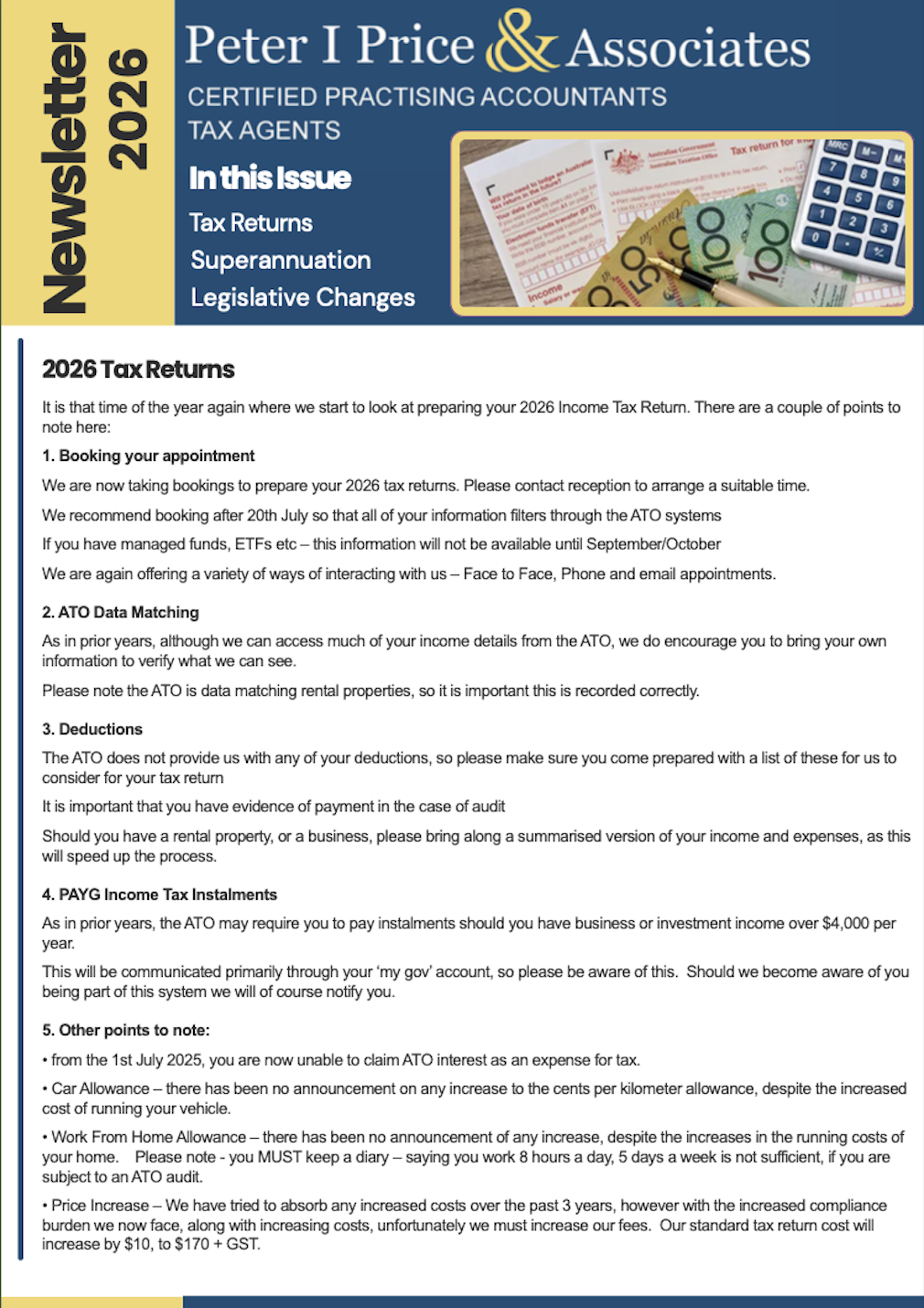
2026 EOFY Newsletter

Secure File Transfer

Secure File Transfer is a facility that allows the safe and secure exchange of confidential files or documents between you and us.

Email is very convenient in our business world, there is no doubting that. However email messages and attachments can be intercepted by third parties, putting your privacy and identity at risk if used to send confidential files or documents. Secure File Transfer eliminates this risk.

Login to Secure File Transfer, or contact us if you require a username and password.

Disclaimer

Information provided on this web site is general in nature and does not constitute financial advice.

Peter Price & Associates has taken reasonable care in providing this information, unless expressly stated, it should not be construed as being specific to your investment objectives, financial situation or particular needs.

Peter Price & Associates will endeavour to update the web site as needed. However, information can change without notice and Peter Price & Associates does not guarantee the accuracy of information on the web site, including information provided by third parties, at any particular time.

This information is prepared for residents of Australia only. Any currency references are references to Australian dollars unless otherwise specified.

Unless otherwise specified, copyright of information provided on this web site is owned by Peter Price & Associates. You may not alter or modify this information in any way, including the removal of this copyright notice.

This web site does not offer securities or other financial products, nor does it invite subscriptions for securities or other financial products to any person outside Australia. Peter Price & Associates does not guarantee the repayment of capital or any particular return from, or any increase in, the value of any Peter Price & Associates products unless otherwise expressly agreed.

Further, Peter Price & Associates disclaims any liability for loss, damage, cost or other expense which you may incur as a result of any information provided on this web site, to the extent that such liability is not excluded by law.

Terms of Payment

Peter Price & Associates Pty Ltd adopts a strict 14 day payment term for all accounts rendered. Full payment of fees must be made 14 days from date of each invoice, unless otherwise agreed upon by Peter Price & Associates Pty Ltd.

You have the options of paying by credit card (Master Card or Visa Card), cash, cheque, money order, direct credit, or we can deduct our fees from your ATO refund. Please contact us for account details if your choose to direct credit to our account, we can also accept credit card payments via phone.

In the event that your payment is late, to the extent permitted by law, interest and charges for late payment will begin to accrue after 30 days from the due date. Payment plans can be arranged to avoid disruption to services. Any costs incurred by debt collectors will be added to outstanding fees payable.