
Peter Price Logo

Latest News

Latest Intergenerational Report points to stubborn productivity issues that AI cannot fix

Accounting bodies have called on the government to address the nation’s waning productivity growth, income tax reliance and ageing population for the purpose of future generations.


Accounting bodies have called on the government to address the nation’s waning productivity growth, income tax reliance and ageing population for the purpose of future generations.

The Treasury’s 2026 Intergenerational Report (IGR) revealed that Australia’s productivity growth has slowed since the mid-2000s due to “diminishing returns from previous technological waves, the slower spread of frontier innovations across firms, weaker global growth in physical and human capital, declining business dynamism, and reduced gains from globalisation”.

Accounting bodies have said that these findings have reinforced the need for the government to focus on productivity and tax reform.

With government spending projected to increase over the next 40 years, Treasury said that this was an improvement on the previous intergenerational report.

“Spending is projected to increase from 26.6 per cent of gross domestic product (GDP) in 2025–26 to 27.7 per cent in 2065–66, an increase of 1.1 percentage points,” the report said.

While Australia’s waning productivity growth can be supported by AI, sustained growth requires investment, innovation, and economic reform, with the ageing population and fiscal pressures reinforcing the need for tax reform, the accounting body said.

Currently, the 2026 IGR keeps its long-term productivity assumption at 1.2 per cent per year, identical to that at the 2023 IGR.

"The report assumes long-term productivity growth of 1.2 per cent a year. A lot would have to go right for such an estimate to be achieved,” said CPA Australia chief executive Chris Freeland.

"Australia still has a productivity problem. Without stronger productivity growth, it becomes more difficult to lift wages sustainably, improve living standards and strengthen long-term prosperity,” he said.

Interplay between income tax and an ageing population

The 2026 IGR estimated that over the next 40 years to 2066, the number of Australians in the 85-plus age group will triple (from 625,000 today to 1.9 million), and predicted that most of this growth will occur in the 2030s and 2040s.

“As more people move into older age groups, a smaller share of the population will be in the traditional working ages, placing gradual pressure on labour supply,” the report said.

“Australia’s superannuation system is helping people fund their own retirements and reducing pressure on the Age Pension. But as our population ages, government spending on health, aged care and other essential services will continue to rise. The bigger challenge for policymakers is ensuring our tax system can sustainably fund those services into the future,” Freeland said.

This is exacerbated by Australia’s continued overreliance on income taxes, which the ATO’s latest data reveals currently sits at 52.2 per cent of the government’s revenue – a steady increase since its 2020–21 taxation statistics.

Further research by the Institute of Financial Professionals Australia (IFPA) said that the government’s current revenue structure is made narrow and inflexible by this income tax reliance, reinforced by bracket creep.

"Recent GDP growth has been driven largely by Australians working more hours rather than producing more from the hours they work. That is not a sustainable path to stronger living standards," Freeland said.

"Bracket creep is not tax reform. It is tax increases by stealth. Australians deserve greater transparency about how much future government revenue relies on workers being pushed into higher tax brackets over time.”

"The report shows Australia will increasingly rely on fewer workers to fund a growing demand for services. This strengthens the case for comprehensive tax reform that supports growth, investment and economic participation."

AI is not a magic pill

As the AI data centre boom continues, it is having impacts on other parts of the construction sector, with labour supply being drawn away from residential construction, which holds the majority of the 1,834 first-time insolvencies in August, according to CreditorWatch’s August Business Risk Index.

“AI will likely boost productivity by improving efficiency and unlocking new innovations, but there are a wide range of potential future outcomes. Whether the productivity impacts of AI follow the path typical of general-purpose technologies over time will depend on the long-term rates of innovation and adoption, and how Australian businesses, workers and governments engage,” the 2026 IGR read.

While productivity could come out of the AI boom, IPA chief executive Andrew Conway said that tax reform must be implemented in conjunction with investment in AI.

“The Treasurer cannot put the economy and productivity into reverse with tax changes that deter investment and then assume AI will come to the rescue,” Conway said.

“We cannot put all our eggs in the AI basket and hope a possible productivity boost will make up for a shrinking tax base.”

“AI may support productivity over time, but it is not a substitute for policy discipline. Australia needs settings that broaden the tax base, encourage investment and reduce the pressure on workers.”

Freeland added that it is important for Australia to have a clear plan for productivity growth, competitiveness in the global economy, and a more resilient local economy for future generations.

“Australia needs a serious, forward-looking reform process that supports investment, improves productivity and ensures future generations are not left carrying an unsustainable debt burden,” Conway said.


By: Carlos Tse | 29 September 2026 | accountantsdaily.com.au
Hot Issues

Tax

  • Individual, Sole Trader and Company Tax Returns
  • Partnership and Trust Tax returns
  • Annual Reporting
  • Business and Tax Advisory Services
  • Management of ATO Correspondence
  • Self-Managed Superannuation Funds tax returns
  • Investment properties - tax and negative gearing
  • HELP (higher education loans) debts
  • Estate Returns and Financial Statements
  • Interim Management Accounts and Reporting
  • Testamentary Trusts
  • Tax effective business structures
  • GST Advice
  • Capital Gains Tax Advice
  • Taxation Audit Advice
  • Fringe Benefit Tax
  • Liaise with the ATO on your behalf
Contact Us

SMSF

  • The setting up of a SMSF and all administration tasks such as preparation of your trust deed and the completion and lodgement of relevant ATO statements.
  • Ensuring your SMSF is compliant with current superannuation laws and regulations
  • Appointment of Trustees
  • Arrange the Audit of your SMSF
  • Preparation of financial statements
  • Lodgement of tax returns
Contact Us

Business Accounting

  • Accounting and bookkeeping
  • Accounting software advice and assistance
  • Business & company tax returns
  • Statutory Account
  • Management Accounts
  • Taxation – GST & PAYG advice, BAS preparation
  • Liaise with the ATO on your behalf
  • Tax Audit advice
  • Business ‘start up’ advice
  • Prepare Business plans and financial budgets and review these regularly
  • Measure your performance against industry benchmarks
  • Trust & company structures
  • Queensland Building & Construction Commission reviews
Contact Us

Tax & Accounting Consultancy

  • Strategic advice to managers about the financial implications of projects
  • Development and Monitoring of KPI's
  • KPI reporting
  • Explaining the financial consequences of business decisions
  • Formulating business budgets and business plans and strategies
  • Monitoring spending, financial control and Cashflow projection
  • Conducting internal business audits
  • Monthly/quarterly management reports
  • Product costing reviews.
Contact Us

Business Advisory

  • Business takeovers
  • Valuation of business
  • Due diligence reports
  • Due diligence services
  • Business risk profiles
  • Specialist Tax advice
  • Tax planning
Contact Us

Corporate Compliance

  • The formation of trusts and new company registrations
  • Preparation of annual company statements
  • Attending to ASIC returns and regular filings on your behalf
  • Filing of any company changes or change of directors
  • Business name registrations and maintenance
  • Renewal of business name/s and other registrations
  • Share allotments/transfers/buy-backs
  • Unit Trusts and allotment/transfer of units and change of Trustee
  • Family Trust set up and change of Trustees
  • Provision of registered office services for service of notices
Contact Us

Tax Diary

General Calculators


Accounting Videos

Tax Deductions

Documents & Forms

Please click the links below to download.

Downloadable data forms to help you maximise your return

Latest Newsletter

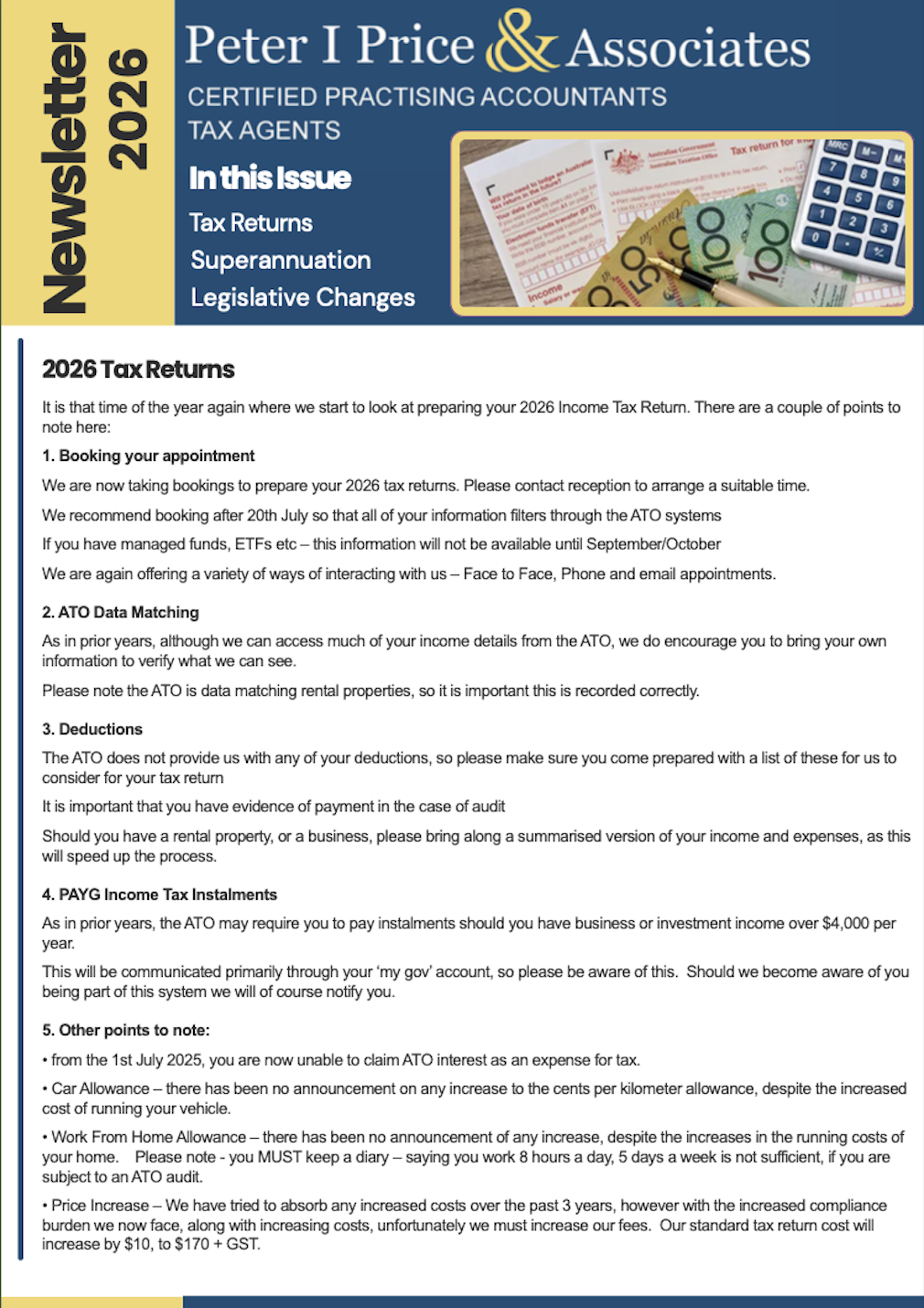
2026 EOFY Newsletter

Secure File Transfer

Secure File Transfer is a facility that allows the safe and secure exchange of confidential files or documents between you and us.

Email is very convenient in our business world, there is no doubting that. However email messages and attachments can be intercepted by third parties, putting your privacy and identity at risk if used to send confidential files or documents. Secure File Transfer eliminates this risk.

Login to Secure File Transfer, or contact us if you require a username and password.

Disclaimer

Information provided on this web site is general in nature and does not constitute financial advice.

Peter Price & Associates has taken reasonable care in providing this information, unless expressly stated, it should not be construed as being specific to your investment objectives, financial situation or particular needs.

Peter Price & Associates will endeavour to update the web site as needed. However, information can change without notice and Peter Price & Associates does not guarantee the accuracy of information on the web site, including information provided by third parties, at any particular time.

This information is prepared for residents of Australia only. Any currency references are references to Australian dollars unless otherwise specified.

Unless otherwise specified, copyright of information provided on this web site is owned by Peter Price & Associates. You may not alter or modify this information in any way, including the removal of this copyright notice.

This web site does not offer securities or other financial products, nor does it invite subscriptions for securities or other financial products to any person outside Australia. Peter Price & Associates does not guarantee the repayment of capital or any particular return from, or any increase in, the value of any Peter Price & Associates products unless otherwise expressly agreed.

Further, Peter Price & Associates disclaims any liability for loss, damage, cost or other expense which you may incur as a result of any information provided on this web site, to the extent that such liability is not excluded by law.

Terms of Payment

Peter Price & Associates Pty Ltd adopts a strict 14 day payment term for all accounts rendered. Full payment of fees must be made 14 days from date of each invoice, unless otherwise agreed upon by Peter Price & Associates Pty Ltd.

You have the options of paying by credit card (Master Card or Visa Card), cash, cheque, money order, direct credit, or we can deduct our fees from your ATO refund. Please contact us for account details if your choose to direct credit to our account, we can also accept credit card payments via phone.

In the event that your payment is late, to the extent permitted by law, interest and charges for late payment will begin to accrue after 30 days from the due date. Payment plans can be arranged to avoid disruption to services. Any costs incurred by debt collectors will be added to outstanding fees payable.