Peter Price Logo

Latest News

ATO issues new guidance on penalties for non-compliance with STP

The Tax Office has published a draft law administration practice statement outlining its approach to penalties for failing to meet reporting obligations for single touch payroll.

.

The ATO has published Practice Statement Law Administration PS LA 2026/D2, which explains how ATO staff should administer penalties when an entity fails to accurately and on time comply with its single touch payroll reporting obligations.

PS LA 2026/D2 also includes information on how ATO staff should administer penalty remission where appropriate.

The draft practice statement sets out a five-step process for ATO staff to follow when raising penalties against an entity for failing to comply with its STP reporting obligations.

The first step explains how ATO staff determine the type of penalty applicable to the entity's circumstances.

PS LA 2026/D2 outlined two types of conduct that can make an entity liable to an administrative penalty. These include failing to lodge STP reporting or lodging STP reporting but failing to do so in the approved form.

An entity is also liable to an administrative penalty if they make a statement in its STP reporting that is false or misleading in a material particular.

The ATO stated that if an entity makes several false or misleading statements in the same document, the entity is liable to a penalty for each statement.

"For example, an entity that makes a false or misleading statement relating to each of their 10 employees has made 10 statements and will be liable to 10 administrative penalties," it said.

For step two, ATO staff are required to consider whether the law protects the entity from penalties given the entity's circumstances.

"An entity will not be liable to a false or misleading statement penalty where they and their agent took reasonable care in connection with making the statement," the practice statement said.

When assessing an entity's behaviour in making a statement, the ATO said staff must consider the actions and behaviours at the time the statement was made. It noted that Miscellaneous Taxation Ruling MT 2008/1 provides guidelines for determining whether an entity took reasonable care.

"The 'reasonable care test' requires an entity to make a reasonable and genuine attempt to comply with obligations imposed under legislative requirements. This means considering actions leading up to the making of the statement," the practice statement said.

"Making a genuine attempt means that the entity was actively engaged with the tax and superannuation systems and actively attempting to comply with their reporting obligations. When considering if a genuine attempt has been made, we compare the entity's attempt with that of other entities in similar circumstances."

The draft practice statement said there were a range of factors that were relevant for assessing reasonable care.

Where there is an inadvertent mistake, the ATO said staff should examine whether reasonable enquiries were made, including whether the entity conducted an enquiry commensurate with the risk of the decision and its resources, or whether the entity simply assumed the statement was correct.

It also said ATO staff should look at:

  • Whether the entity was aware, or should have been aware, of the correct treatment of the law or of the facts.
  • Whether any factors prevented the entity from seeking advice, understanding the requirements of the tax law or reporting correctly, and
  • Whether the entity's level of knowledge, understanding of the tax and superannuation systems or circumstances impacted their compliance.


The practice statement also noted that an entity is not liable for a false or misleading statement penalty if it corrects a false or misleading statement made in the course of its STP reporting within a prescribed period.

PS LA 2026/D2 also sets out how the safe harbour exception applies for entities where an agent has failed to take reasonable care:

"In relation to penalties for failing to lodge in the approved form by the due date, the safe harbour applies where all of the following apply:

  • The entity provided all relevant information to the registered agent to enable the document to be lodged on time (noting that the onus is on the entity to prove that they met this requirement).
  • The registered agent does not lodge the document on time, and
  • The failure to lodge on time was not due to either
    •  Intentional disregard of a taxation law by the registered agent, or
    •  Recklessness by the registered agent as to the operation of a taxation law."

"Entities that engage the services of third-party payroll service providers are not protected from penalties by the safe harbours for the actions of the payroll service provider unless the third-party payroll service provider is also a registered tax or BAS agent," it said.

Steps three and four require ATO staff to determine the extent and amount of the penalty and consider penalty remission. Appendix C sets out a detailed four-step remission process that staff must follow.

Step five outlines what should be included in the written notice of the penalty.

The PS LA 2026/D2 is open for consultation until Friday, 24 April.

In a public statement, the ATO said STP and superannuation member account reporting were critical to the administration of the tax and super systems, and relied on by millions of individuals to manage their tax and super affairs.

"It's essential that this reporting is accurate and lodged on time," it said.

"The draft practice statements will assist ATO staff when applying penalties for STP or superannuation member account reporting that is inaccurate or late."


19 March 2026
Miranda Brownlee
accountantsdaily.com.au
Hot Issues

Tax

  • Individual, Sole Trader and Company Tax Returns
  • Partnership and Trust Tax returns
  • Annual Reporting
  • Business and Tax Advisory Services
  • Management of ATO Correspondence
  • Self-Managed Superannuation Funds tax returns
  • Investment properties - tax and negative gearing
  • HELP (higher education loans) debts
  • Estate Returns and Financial Statements
  • Interim Management Accounts and Reporting
  • Testamentary Trusts
  • Tax effective business structures
  • GST Advice
  • Capital Gains Tax Advice
  • Taxation Audit Advice
  • Fringe Benefit Tax
  • Liaise with the ATO on your behalf
Contact Us

SMSF

  • The setting up of a SMSF and all administration tasks such as preparation of your trust deed and the completion and lodgement of relevant ATO statements.
  • Ensuring your SMSF is compliant with current superannuation laws and regulations
  • Appointment of Trustees
  • Arrange the Audit of your SMSF
  • Preparation of financial statements
  • Lodgement of tax returns
Contact Us

Business Accounting

  • Accounting and bookkeeping
  • Accounting software advice and assistance
  • Business & company tax returns
  • Statutory Account
  • Management Accounts
  • Taxation – GST & PAYG advice, BAS preparation
  • Liaise with the ATO on your behalf
  • Tax Audit advice
  • Business ‘start up’ advice
  • Prepare Business plans and financial budgets and review these regularly
  • Measure your performance against industry benchmarks
  • Trust & company structures
  • Queensland Building & Construction Commission reviews
Contact Us

Tax & Accounting Consultancy

  • Strategic advice to managers about the financial implications of projects
  • Development and Monitoring of KPI's
  • KPI reporting
  • Explaining the financial consequences of business decisions
  • Formulating business budgets and business plans and strategies
  • Monitoring spending, financial control and Cashflow projection
  • Conducting internal business audits
  • Monthly/quarterly management reports
  • Product costing reviews.
Contact Us

Business Advisory

  • Business takeovers
  • Valuation of business
  • Due diligence reports
  • Due diligence services
  • Business risk profiles
  • Specialist Tax advice
  • Tax planning
Contact Us

Corporate Compliance

  • The formation of trusts and new company registrations
  • Preparation of annual company statements
  • Attending to ASIC returns and regular filings on your behalf
  • Filing of any company changes or change of directors
  • Business name registrations and maintenance
  • Renewal of business name/s and other registrations
  • Share allotments/transfers/buy-backs
  • Unit Trusts and allotment/transfer of units and change of Trustee
  • Family Trust set up and change of Trustees
  • Provision of registered office services for service of notices
Contact Us

Tax Diary

General Calculators


Accounting Videos

Tax Deductions

Documents & Forms

Please click the links below to download.

Downloadable data forms to help you maximise your return

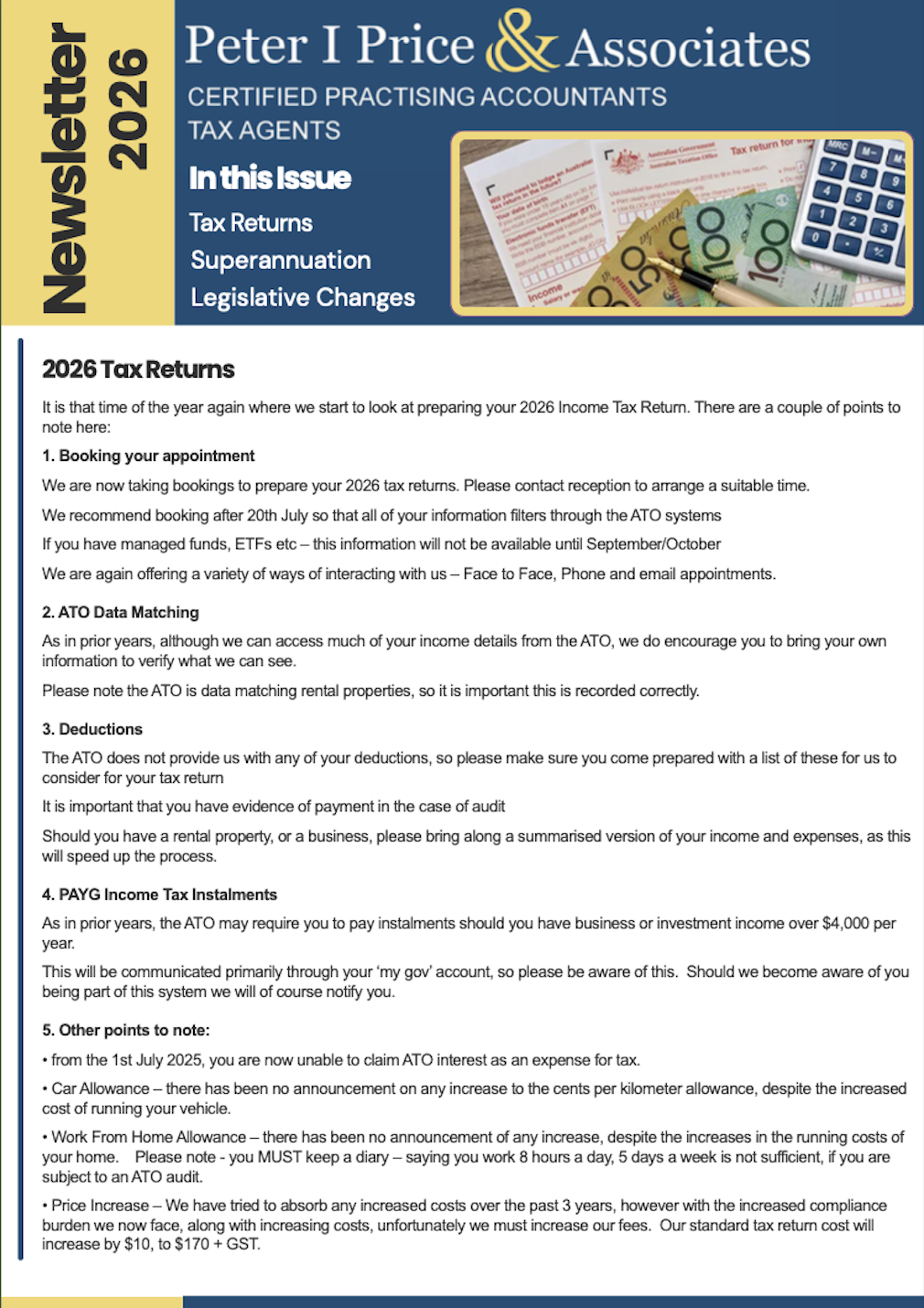
Latest Newsletter

2025 EOFY Newsletter

Secure File Transfer

Secure File Transfer is a facility that allows the safe and secure exchange of confidential files or documents between you and us.

Email is very convenient in our business world, there is no doubting that. However email messages and attachments can be intercepted by third parties, putting your privacy and identity at risk if used to send confidential files or documents. Secure File Transfer eliminates this risk.

Login to Secure File Transfer, or contact us if you require a username and password.

Disclaimer

Information provided on this web site is general in nature and does not constitute financial advice.

Peter Price & Associates has taken reasonable care in providing this information, unless expressly stated, it should not be construed as being specific to your investment objectives, financial situation or particular needs.

Peter Price & Associates will endeavour to update the web site as needed. However, information can change without notice and Peter Price & Associates does not guarantee the accuracy of information on the web site, including information provided by third parties, at any particular time.

This information is prepared for residents of Australia only. Any currency references are references to Australian dollars unless otherwise specified.

Unless otherwise specified, copyright of information provided on this web site is owned by Peter Price & Associates. You may not alter or modify this information in any way, including the removal of this copyright notice.

This web site does not offer securities or other financial products, nor does it invite subscriptions for securities or other financial products to any person outside Australia. Peter Price & Associates does not guarantee the repayment of capital or any particular return from, or any increase in, the value of any Peter Price & Associates products unless otherwise expressly agreed.

Further, Peter Price & Associates disclaims any liability for loss, damage, cost or other expense which you may incur as a result of any information provided on this web site, to the extent that such liability is not excluded by law.

Terms of Payment

Peter Price & Associates Pty Ltd adopts a strict 14 day payment term for all accounts rendered. Full payment of fees must be made 14 days from date of each invoice, unless otherwise agreed upon by Peter Price & Associates Pty Ltd.

You have the options of paying by credit card (Master Card or Visa Card), cash, cheque, money order, direct credit, or we can deduct our fees from your ATO refund. Please contact us for account details if your choose to direct credit to our account, we can also accept credit card payments via phone.

In the event that your payment is late, to the extent permitted by law, interest and charges for late payment will begin to accrue after 30 days from the due date. Payment plans can be arranged to avoid disruption to services. Any costs incurred by debt collectors will be added to outstanding fees payable.