Peter Price Logo

Latest News

When to Update Your Business Trading Terms

Trading terms are the contract that outlines how you do business. They provide an overview of the rights and obligations of you and your customers.

.

Your trading terms should include details on the goods or services you provide, customer payment obligations, and how you manage risk, liability and potential disputes.

Your business faces risk if you use outdated trading terms. Knowing when to update these terms is important so that you can stay compliant and operate effectively. This article explains the signs that your trading terms need updating, the legal risks of non-compliance, key elements of modern terms, and the importance of professional review.

Signs Your Trading Terms Need Updating

You should regularly review your trading terms as a crucial business practice. If you experience recurring issues or your business has evolved, it is time for an update.

Update your trading terms when you:

  • introduce new products or services;
  • expand to sell overseas;
  • change your payment processes or delivery methods; and
  • modify your business operations in any significant way.

If you have not updated your terms for several years, they likely do not reflect current laws or your business operations. Terms that were compliant years ago may no longer be suitable.

If customers repeatedly misunderstand provisions in your terms, this clearly shows your terms are ambiguous or no longer fit for purpose.

Using outdated terms exposes your business to risks:

  1. Unfair Contract Terms: A significant risk is non-compliance with the Unfair Contract Terms (UCT) regime under the Australian Consumer Law (ACL). This came into effect on 9 November 2023. The law considers a term unfair if it: causes a significant imbalance in rights, is not necessary to protect legitimate interests or would cause detriment if enforced. An example of a UCT is a term that allows only one party to unilaterally end the contract. A term deemed as a UCT may be unenforceable and void.
  2. Consumer Guarantees: If your business sells to consumers (rather than other businesses), outdated terms may contain clauses that attempt to limit consumer rights under the ACL. For example, a clause stating ‘no refunds or returns under any circumstances’ is illegal. It denies consumers their right to a remedy when a product is faulty. Such clauses are void. Relying on them can expose your business to legal action from consumers and the ACCC, which regularly audits Australian businesses for non-compliance.
  3. Unprotected Intellectual Property (IP): If your business has developed new branding, software, or other valuable IP, your old terms may not provide adequate protection. They might fail to specify ownership of IP created during service delivery. This leaves your proprietary information vulnerable to misuse or infringement.

Key Elements in Trading Terms 

You should ensure your trading terms cover several key elements: 

  • Payment Terms: Your terms must specify the price of your goods or services, accepted payment methods, payment due dates and any interest applied to late payments.  
  • Parties’ Obligations: The terms should accurately describe the goods or services you provide. They must also outline the obligations of both your business and the customer, including delivery terms, who holds the risk for loss or damage during transit, and any warranties you provide.
  • Intellectual Property and Confidentiality: Your terms should clearly state who owns any intellectual property created and should obligate both parties to keep confidential information private.
  • Dispute Resolution: This outlines a clear process for handling disagreements between the parties. This typically involves requiring parties to attempt negotiation or mediation before resorting to costly court proceedings.
  • Limitation of Liability: Your terms should clearly define the extent of your business’ liability if something goes wrong. This includes specifying any caps on liability amounts and excluding liability for certain types of loss (such as indirect or consequential losses). However, you must ensure these limitations comply with the UCT regime and cannot exclude liability that Australian law requires you to accept, such as liability for breaching consumer guarantees.
  • Termination: This clause establishes how and when either party can end the contract, including required notice periods and consequences of termination, such as final payment of outstanding invoices and return of any materials

Key Takeaways

Successfully managing your business requires a proactive approach to your trading terms. Regularly review and update your terms to reflect changes in your business and the law. Ensure your contracts comply with the Unfair Contract Terms regime to avoid significant financial penalties. By investing in professionally drafted and reviewed trading terms, you can build trust with your customers and protect your business’ legal and financial interests. 


Danielle Henry
12 February 2026
legalvision.com.au
Hot Issues

Tax

  • Individual, Sole Trader and Company Tax Returns
  • Partnership and Trust Tax returns
  • Annual Reporting
  • Business and Tax Advisory Services
  • Management of ATO Correspondence
  • Self-Managed Superannuation Funds tax returns
  • Investment properties - tax and negative gearing
  • HELP (higher education loans) debts
  • Estate Returns and Financial Statements
  • Interim Management Accounts and Reporting
  • Testamentary Trusts
  • Tax effective business structures
  • GST Advice
  • Capital Gains Tax Advice
  • Taxation Audit Advice
  • Fringe Benefit Tax
  • Liaise with the ATO on your behalf
Contact Us

SMSF

  • The setting up of a SMSF and all administration tasks such as preparation of your trust deed and the completion and lodgement of relevant ATO statements.
  • Ensuring your SMSF is compliant with current superannuation laws and regulations
  • Appointment of Trustees
  • Arrange the Audit of your SMSF
  • Preparation of financial statements
  • Lodgement of tax returns
Contact Us

Business Accounting

  • Accounting and bookkeeping
  • Accounting software advice and assistance
  • Business & company tax returns
  • Statutory Account
  • Management Accounts
  • Taxation – GST & PAYG advice, BAS preparation
  • Liaise with the ATO on your behalf
  • Tax Audit advice
  • Business ‘start up’ advice
  • Prepare Business plans and financial budgets and review these regularly
  • Measure your performance against industry benchmarks
  • Trust & company structures
  • Queensland Building & Construction Commission reviews
Contact Us

Tax & Accounting Consultancy

  • Strategic advice to managers about the financial implications of projects
  • Development and Monitoring of KPI's
  • KPI reporting
  • Explaining the financial consequences of business decisions
  • Formulating business budgets and business plans and strategies
  • Monitoring spending, financial control and Cashflow projection
  • Conducting internal business audits
  • Monthly/quarterly management reports
  • Product costing reviews.
Contact Us

Business Advisory

  • Business takeovers
  • Valuation of business
  • Due diligence reports
  • Due diligence services
  • Business risk profiles
  • Specialist Tax advice
  • Tax planning
Contact Us

Corporate Compliance

  • The formation of trusts and new company registrations
  • Preparation of annual company statements
  • Attending to ASIC returns and regular filings on your behalf
  • Filing of any company changes or change of directors
  • Business name registrations and maintenance
  • Renewal of business name/s and other registrations
  • Share allotments/transfers/buy-backs
  • Unit Trusts and allotment/transfer of units and change of Trustee
  • Family Trust set up and change of Trustees
  • Provision of registered office services for service of notices
Contact Us

Tax Diary

General Calculators


Accounting Videos

Tax Deductions

Documents & Forms

Please click the links below to download.

Downloadable data forms to help you maximise your return

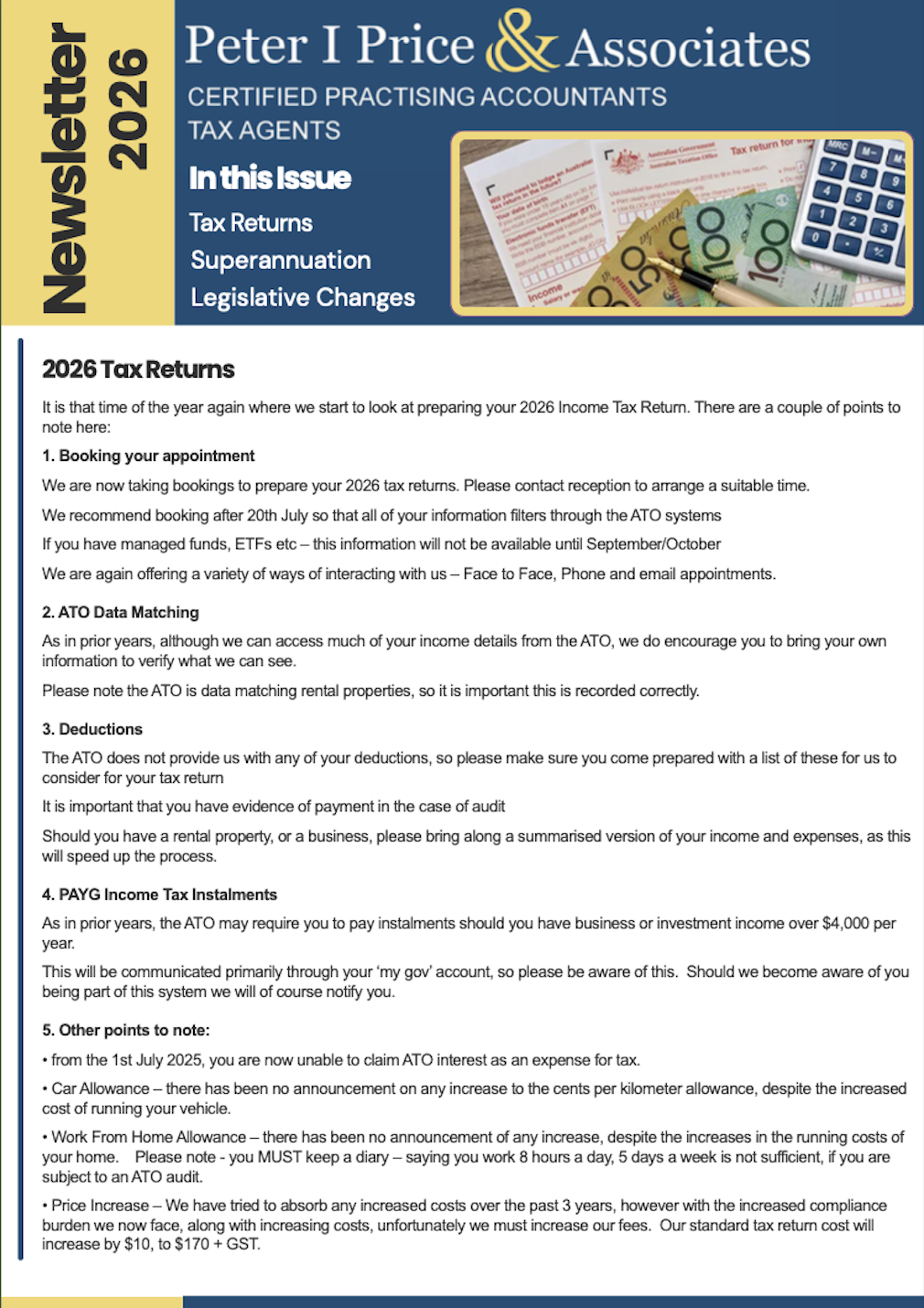
Latest Newsletter

2025 EOFY Newsletter

Secure File Transfer

Secure File Transfer is a facility that allows the safe and secure exchange of confidential files or documents between you and us.

Email is very convenient in our business world, there is no doubting that. However email messages and attachments can be intercepted by third parties, putting your privacy and identity at risk if used to send confidential files or documents. Secure File Transfer eliminates this risk.

Login to Secure File Transfer, or contact us if you require a username and password.

Disclaimer

Information provided on this web site is general in nature and does not constitute financial advice.

Peter Price & Associates has taken reasonable care in providing this information, unless expressly stated, it should not be construed as being specific to your investment objectives, financial situation or particular needs.

Peter Price & Associates will endeavour to update the web site as needed. However, information can change without notice and Peter Price & Associates does not guarantee the accuracy of information on the web site, including information provided by third parties, at any particular time.

This information is prepared for residents of Australia only. Any currency references are references to Australian dollars unless otherwise specified.

Unless otherwise specified, copyright of information provided on this web site is owned by Peter Price & Associates. You may not alter or modify this information in any way, including the removal of this copyright notice.

This web site does not offer securities or other financial products, nor does it invite subscriptions for securities or other financial products to any person outside Australia. Peter Price & Associates does not guarantee the repayment of capital or any particular return from, or any increase in, the value of any Peter Price & Associates products unless otherwise expressly agreed.

Further, Peter Price & Associates disclaims any liability for loss, damage, cost or other expense which you may incur as a result of any information provided on this web site, to the extent that such liability is not excluded by law.

Terms of Payment

Peter Price & Associates Pty Ltd adopts a strict 14 day payment term for all accounts rendered. Full payment of fees must be made 14 days from date of each invoice, unless otherwise agreed upon by Peter Price & Associates Pty Ltd.

You have the options of paying by credit card (Master Card or Visa Card), cash, cheque, money order, direct credit, or we can deduct our fees from your ATO refund. Please contact us for account details if your choose to direct credit to our account, we can also accept credit card payments via phone.

In the event that your payment is late, to the extent permitted by law, interest and charges for late payment will begin to accrue after 30 days from the due date. Payment plans can be arranged to avoid disruption to services. Any costs incurred by debt collectors will be added to outstanding fees payable.