
Peter Price Logo

Latest News

SMEs to be hit hardest by new trust tax reforms

Australia’s proposed discretionary trust tax reforms could put a significant financial burden on small and family-run businesses, an advisory firm has warned.

.

According to Greg Bartels, director of Halo Advisory, sweeping reforms to capital gains and discretionary trusts in the budget could have the greatest impact on mum-and-dad businesses in the SME sector. 

In a recent opinion piece, Bartels said that under the current system, trust income is generally distributed to beneficiaries and taxed at their individual marginal tax rates. Yet, under the proposed framework, trustees would effectively pay a flat 30 per cent tax upfront, with beneficiaries receiving non-refundable tax credits. 

Discretionary trusts are widely used across Australia because they offer flexibility and asset protection for business owners operating in inherently risky environments. 

So, why would small businesses be impacted the most? 

At the moment, small businesses are often seen as the greatest beneficiaries of discretionary trusts, as they offer flexibility in distributing profits to family members in lower tax brackets, help shield business assets from personal liabilities, and allow for a 50 per cent discount on CGT.

But under the proposed reforms, many of these businesses may face a higher effective tax burden purely because of the structure they use to operate safely and efficiently.

Trustees will effectively pay a flat 30 per cent tax upfront on distributions. While beneficiaries receive corresponding tax credits, those credits are non-refundable. 

For high-income earners already paying tax above 30 per cent, the practical impact may be limited. 

However, Bartels said that for everyday SMEs that rely on discretionary trusts for flexibility, succession planning, and asset protection, the reforms could materially increase the overall tax burden and affect cash flow, despite no change in underlying business profitability. 

“For many small business families, the concern is not just about tax – it’s about cash flow,” he said. 

“Businesses could end up paying materially more tax despite earning the same income.”

Analysis from Halo Advisory suggested the reforms have the potential to force many SMEs to reconsider long-standing business structures designed around asset protection and succession planning.

“Operating through a trust structure has often been about protecting the family home or separating business risk from personal assets,” Bartels said. 

“The challenge now is that maintaining those protections may come with a significantly higher ongoing tax cost.” 

If a husband-and-wife business operating through a discretionary family trust generated $200,000 in annual profit, under the current regulations, distributing profits evenly may result in an effective family tax rate of approximately 22 per cent. 

However, under the proposed changes, the situation is seemingly more unfortunate as the family’s tax burden may increase substantially because excess tax credits cannot be refunded, resulting in a direct reduction in household cash flow. 

For many SMEs already managing rising wages, Bartel said that supply chain costs, insurance increases, interest rate pressure, and losing an additional $10,000–$20,000 in annual liquidity could materially affect hiring decisions, reinvestment plans, and long-term business stability. 

Accordingly, many business owners are depicting the reforms not as a tax impartiality measure, but moreso as a structural reset for the SME sector. 

As such, for many SMEs, restructuring will be more than just a basic practice; it could fundamentally change how their businesses operate in the long term. 

These concerns are leading to many critiques and particular business owners questioning, what does the future look like for small businesses? 

Many small business owners are not large-scale tax minimisers and are simply trying to build sustainable businesses that employ staff. 

Such reforms not only impose an additional burden on these SMEs in terms of cash flow, but also, when small businesses lose liquidity, reduce investment, hiring, and overall business growth. 

Regardless of whether these reforms proceed in their current form or evolve through consultation, Bartels said, business owners should begin assessing their structures now.


27 May 2026
Miranda Brownlee
accountantsdaily.com.au
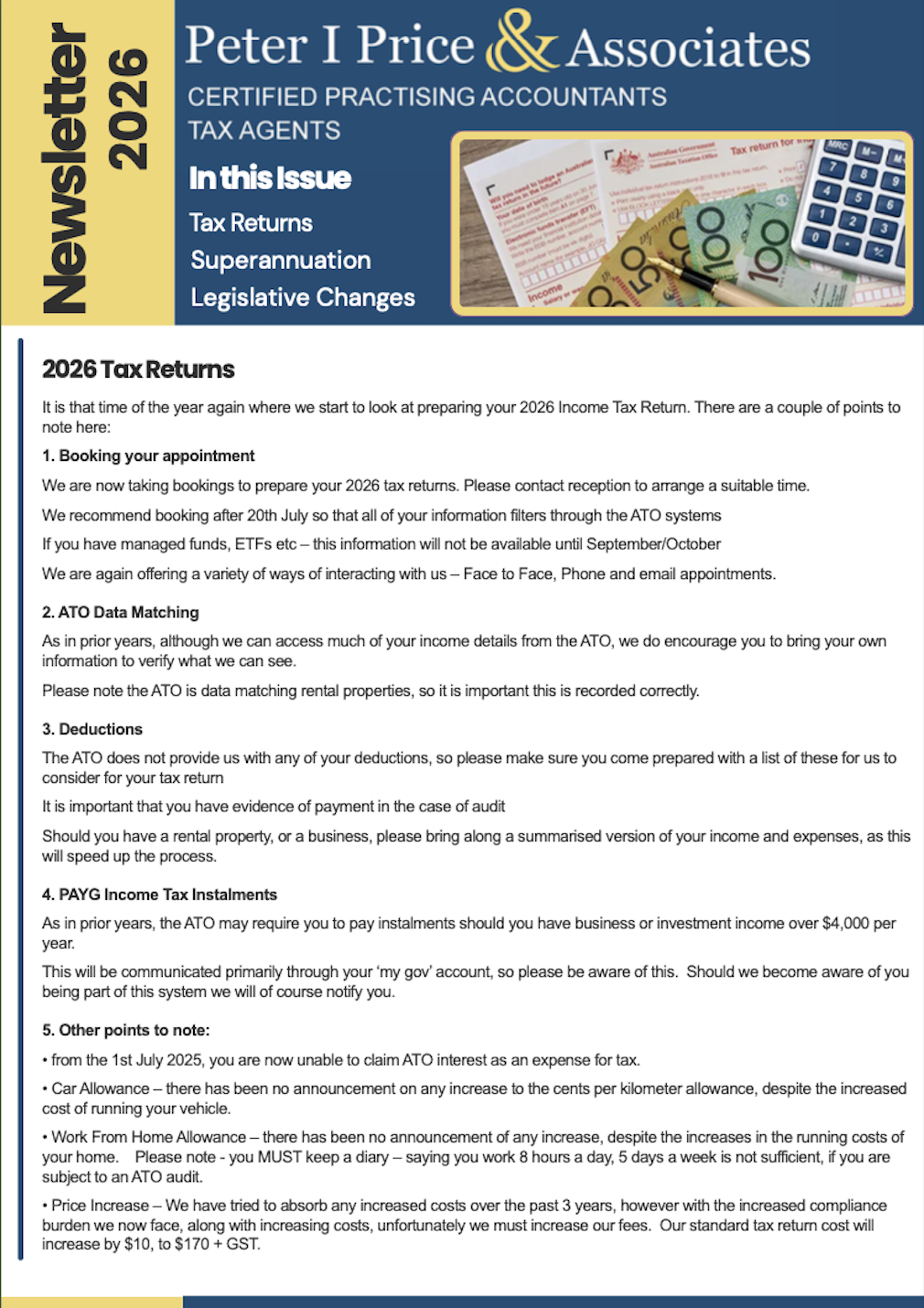
Hot Issues

Tax

  • Individual, Sole Trader and Company Tax Returns
  • Partnership and Trust Tax returns
  • Annual Reporting
  • Business and Tax Advisory Services
  • Management of ATO Correspondence
  • Self-Managed Superannuation Funds tax returns
  • Investment properties - tax and negative gearing
  • HELP (higher education loans) debts
  • Estate Returns and Financial Statements
  • Interim Management Accounts and Reporting
  • Testamentary Trusts
  • Tax effective business structures
  • GST Advice
  • Capital Gains Tax Advice
  • Taxation Audit Advice
  • Fringe Benefit Tax
  • Liaise with the ATO on your behalf
Contact Us

SMSF

  • The setting up of a SMSF and all administration tasks such as preparation of your trust deed and the completion and lodgement of relevant ATO statements.
  • Ensuring your SMSF is compliant with current superannuation laws and regulations
  • Appointment of Trustees
  • Arrange the Audit of your SMSF
  • Preparation of financial statements
  • Lodgement of tax returns
Contact Us

Business Accounting

  • Accounting and bookkeeping
  • Accounting software advice and assistance
  • Business & company tax returns
  • Statutory Account
  • Management Accounts
  • Taxation – GST & PAYG advice, BAS preparation
  • Liaise with the ATO on your behalf
  • Tax Audit advice
  • Business ‘start up’ advice
  • Prepare Business plans and financial budgets and review these regularly
  • Measure your performance against industry benchmarks
  • Trust & company structures
  • Queensland Building & Construction Commission reviews
Contact Us

Tax & Accounting Consultancy

  • Strategic advice to managers about the financial implications of projects
  • Development and Monitoring of KPI's
  • KPI reporting
  • Explaining the financial consequences of business decisions
  • Formulating business budgets and business plans and strategies
  • Monitoring spending, financial control and Cashflow projection
  • Conducting internal business audits
  • Monthly/quarterly management reports
  • Product costing reviews.
Contact Us

Business Advisory

  • Business takeovers
  • Valuation of business
  • Due diligence reports
  • Due diligence services
  • Business risk profiles
  • Specialist Tax advice
  • Tax planning
Contact Us

Corporate Compliance

  • The formation of trusts and new company registrations
  • Preparation of annual company statements
  • Attending to ASIC returns and regular filings on your behalf
  • Filing of any company changes or change of directors
  • Business name registrations and maintenance
  • Renewal of business name/s and other registrations
  • Share allotments/transfers/buy-backs
  • Unit Trusts and allotment/transfer of units and change of Trustee
  • Family Trust set up and change of Trustees
  • Provision of registered office services for service of notices
Contact Us

Tax Diary

General Calculators


Accounting Videos

Tax Deductions

Documents & Forms

Please click the links below to download.

Downloadable data forms to help you maximise your return

Latest Newsletter

2025 EOFY Newsletter

Secure File Transfer

Secure File Transfer is a facility that allows the safe and secure exchange of confidential files or documents between you and us.

Email is very convenient in our business world, there is no doubting that. However email messages and attachments can be intercepted by third parties, putting your privacy and identity at risk if used to send confidential files or documents. Secure File Transfer eliminates this risk.

Login to Secure File Transfer, or contact us if you require a username and password.

Disclaimer

Information provided on this web site is general in nature and does not constitute financial advice.

Peter Price & Associates has taken reasonable care in providing this information, unless expressly stated, it should not be construed as being specific to your investment objectives, financial situation or particular needs.

Peter Price & Associates will endeavour to update the web site as needed. However, information can change without notice and Peter Price & Associates does not guarantee the accuracy of information on the web site, including information provided by third parties, at any particular time.

This information is prepared for residents of Australia only. Any currency references are references to Australian dollars unless otherwise specified.

Unless otherwise specified, copyright of information provided on this web site is owned by Peter Price & Associates. You may not alter or modify this information in any way, including the removal of this copyright notice.

This web site does not offer securities or other financial products, nor does it invite subscriptions for securities or other financial products to any person outside Australia. Peter Price & Associates does not guarantee the repayment of capital or any particular return from, or any increase in, the value of any Peter Price & Associates products unless otherwise expressly agreed.

Further, Peter Price & Associates disclaims any liability for loss, damage, cost or other expense which you may incur as a result of any information provided on this web site, to the extent that such liability is not excluded by law.

Terms of Payment

Peter Price & Associates Pty Ltd adopts a strict 14 day payment term for all accounts rendered. Full payment of fees must be made 14 days from date of each invoice, unless otherwise agreed upon by Peter Price & Associates Pty Ltd.

You have the options of paying by credit card (Master Card or Visa Card), cash, cheque, money order, direct credit, or we can deduct our fees from your ATO refund. Please contact us for account details if your choose to direct credit to our account, we can also accept credit card payments via phone.

In the event that your payment is late, to the extent permitted by law, interest and charges for late payment will begin to accrue after 30 days from the due date. Payment plans can be arranged to avoid disruption to services. Any costs incurred by debt collectors will be added to outstanding fees payable.