
Peter Price Logo

Latest News

Digital Assets You Forgot You Own (and Why They Still Matter at Tax Time)

Forgotten digital assets like old domains, online wallets and unused subscriptions can carry tax consequences in Australia. Here's what the ATO wants you to know.

.

Key Highlights

  • Digital assets include domains, online wallets, subscriptions, and income platforms
  • Forgotten assets can result in unclaimed income or tax reporting gaps
  • Managing domain names is one example of staying on top of digital ownership
  • A quick digital audit before tax time helps reduce costs and avoid mistakes

When you think about what needs sorting before tax time, your mind probably goes straight to invoices, receipts, or maybe that shoebox of expense records. What usually doesn’t make the list? Digital assets. Not just the obvious ones like crypto — we’re talking about the forgotten stuff. That domain you bought five years ago for a side project. The PayPal account with a lingering balance. A design software subscription that still bills you every quarter.

These digital remnants of past ideas or old routines might seem trivial, but they don’t disappear just because you’ve moved on. They can carry real financial value, attract ongoing charges, and in some cases, require reporting to the ATO. The more digital our lives become, the easier it is to overlook assets that live behind logins and email alerts.

You don’t need to be in tech or business to have digital assets. If you've ever bought a domain, earned money online, used cloud tools, or sold something through a digital platform, you’re in the picture. And what you’ve forgotten could quietly affect your records — especially as the ATO starts looking more closely at digital activity.

What Counts as a Digital Asset (and Why the ATO Cares)

Digital assets aren’t limited to investment tools like crypto or NFTs. In tax terms, they can include anything owned or controlled in digital form that holds value or generates income. Think domain names, PayPal and Stripe accounts, cloud storage credits, software subscriptions, digital products, online memberships and loyalty point balances.

The ATO has already flagged digital asset tracking as a growing focus area. They're paying closer attention to undeclared online income, capital gains on digital sales, and deductions linked to digital tools. That includes small business operators, sole traders, side hustlers, and even individuals who’ve passively held online assets for years.

Unlike physical assets, digital ones tend to stay hidden — until they pop up in bank statements or audit trails. That’s why the ATO’s data-matching programs increasingly scan for payment platform activity, crypto wallets, and business tools with financial links. Whether or not the asset is active, ownership alone may carry tax consequences.

Common Digital Assets Australians Forget They Own

It’s surprisingly easy to lose track of what’s still in your name. A domain purchased during a uni project. A few hundred dollars sitting in an old PayPal account. A Canva Pro subscription still charging your card. Accounts on platforms like Etsy or Gumroad with small earnings that never made it to your bank.

Crypto wallets with forgotten tokens. Old eCommerce storefronts. Cloud services or website hosting packages that auto-renew. Affiliate platform earnings you didn’t realise were taxable. These aren’t niche problems — they’re everyday scenarios. And while none of them might seem significant on their own, they can add up to messy tax returns or missed deductions.

Tax Time Risks of Forgotten Digital Assets

The ATO doesn’t just care about what you’re actively using. They care about what’s in your name, what earns income, and what changes in value. If you’ve sold a domain, cashed out a token, or let a digital asset expire after it had been linked to business activity, there may be tax implications — even if you forgot it was there.

You might be paying for things you no longer use, like subscriptions or storage. You might also be entitled to deductions you’re not claiming, simply because you overlooked a tool that’s technically still part of your workflow. If you’ve made money through digital platforms but didn’t report it, you could end up under-declaring income.

How Domain Names Fit into the Bigger Picture

Domain names are a great example. Plenty of Australians own domains they haven’t used in years. Some were set up for old blogs or side businesses, others for ideas that never launched. But if those domains are still renewing, or were ever linked to a business ABN, they can’t be ignored at tax time.

Effectively managing domain names is a key part of the wider digital clean-up. Knowing what you still control, what’s worth keeping, and what should be written off or sold makes your tax position clearer. Domains can sometimes hold resale value too, which may attract capital gains if sold.

Simple Steps to Reclaim Control Before Tax Time

A simple digital audit is all it takes to stay ahead. Go through your inbox for old subscription receipts. Log into your domain registrar or hosting provider to see what’s still active. Check balances on PayPal, crypto wallets, and online marketplaces. Make note of what’s linked to your business, what you’re still paying for, and anything with income potential.

Work with an accountant who understands digital asset reporting in Australia. The ATO’s approach to digital income is tightening, and guessing your way through it won’t cut it anymore. Even if an asset doesn’t trigger a tax event this year, keeping it on your radar ensures you’re ready when that changes.

Final Thoughts

Digital assets have become part of modern financial life — but they’re often treated like digital dust. Whether it's a domain quietly auto-renewing, a side hustle account you forgot about, or a few dollars in a wallet you haven’t touched in years, the ATO may still want to know about it.

It’s worth taking time before June 30 to look at what you still own online. Because if it holds value, costs money, or ever touched your business activity, it matters more than you think.


31 December 2025
Dominic Vivarini 
accountantsdaily.com.au
Hot Issues

Tax

  • Individual, Sole Trader and Company Tax Returns
  • Partnership and Trust Tax returns
  • Annual Reporting
  • Business and Tax Advisory Services
  • Management of ATO Correspondence
  • Self-Managed Superannuation Funds tax returns
  • Investment properties - tax and negative gearing
  • HELP (higher education loans) debts
  • Estate Returns and Financial Statements
  • Interim Management Accounts and Reporting
  • Testamentary Trusts
  • Tax effective business structures
  • GST Advice
  • Capital Gains Tax Advice
  • Taxation Audit Advice
  • Fringe Benefit Tax
  • Liaise with the ATO on your behalf
Contact Us

SMSF

  • The setting up of a SMSF and all administration tasks such as preparation of your trust deed and the completion and lodgement of relevant ATO statements.
  • Ensuring your SMSF is compliant with current superannuation laws and regulations
  • Appointment of Trustees
  • Arrange the Audit of your SMSF
  • Preparation of financial statements
  • Lodgement of tax returns
Contact Us

Business Accounting

  • Accounting and bookkeeping
  • Accounting software advice and assistance
  • Business & company tax returns
  • Statutory Account
  • Management Accounts
  • Taxation – GST & PAYG advice, BAS preparation
  • Liaise with the ATO on your behalf
  • Tax Audit advice
  • Business ‘start up’ advice
  • Prepare Business plans and financial budgets and review these regularly
  • Measure your performance against industry benchmarks
  • Trust & company structures
  • Queensland Building & Construction Commission reviews
Contact Us

Tax & Accounting Consultancy

  • Strategic advice to managers about the financial implications of projects
  • Development and Monitoring of KPI's
  • KPI reporting
  • Explaining the financial consequences of business decisions
  • Formulating business budgets and business plans and strategies
  • Monitoring spending, financial control and Cashflow projection
  • Conducting internal business audits
  • Monthly/quarterly management reports
  • Product costing reviews.
Contact Us

Business Advisory

  • Business takeovers
  • Valuation of business
  • Due diligence reports
  • Due diligence services
  • Business risk profiles
  • Specialist Tax advice
  • Tax planning
Contact Us

Corporate Compliance

  • The formation of trusts and new company registrations
  • Preparation of annual company statements
  • Attending to ASIC returns and regular filings on your behalf
  • Filing of any company changes or change of directors
  • Business name registrations and maintenance
  • Renewal of business name/s and other registrations
  • Share allotments/transfers/buy-backs
  • Unit Trusts and allotment/transfer of units and change of Trustee
  • Family Trust set up and change of Trustees
  • Provision of registered office services for service of notices
Contact Us

Tax Diary

General Calculators


Accounting Videos

Tax Deductions

Documents & Forms

Please click the links below to download.

Downloadable data forms to help you maximise your return

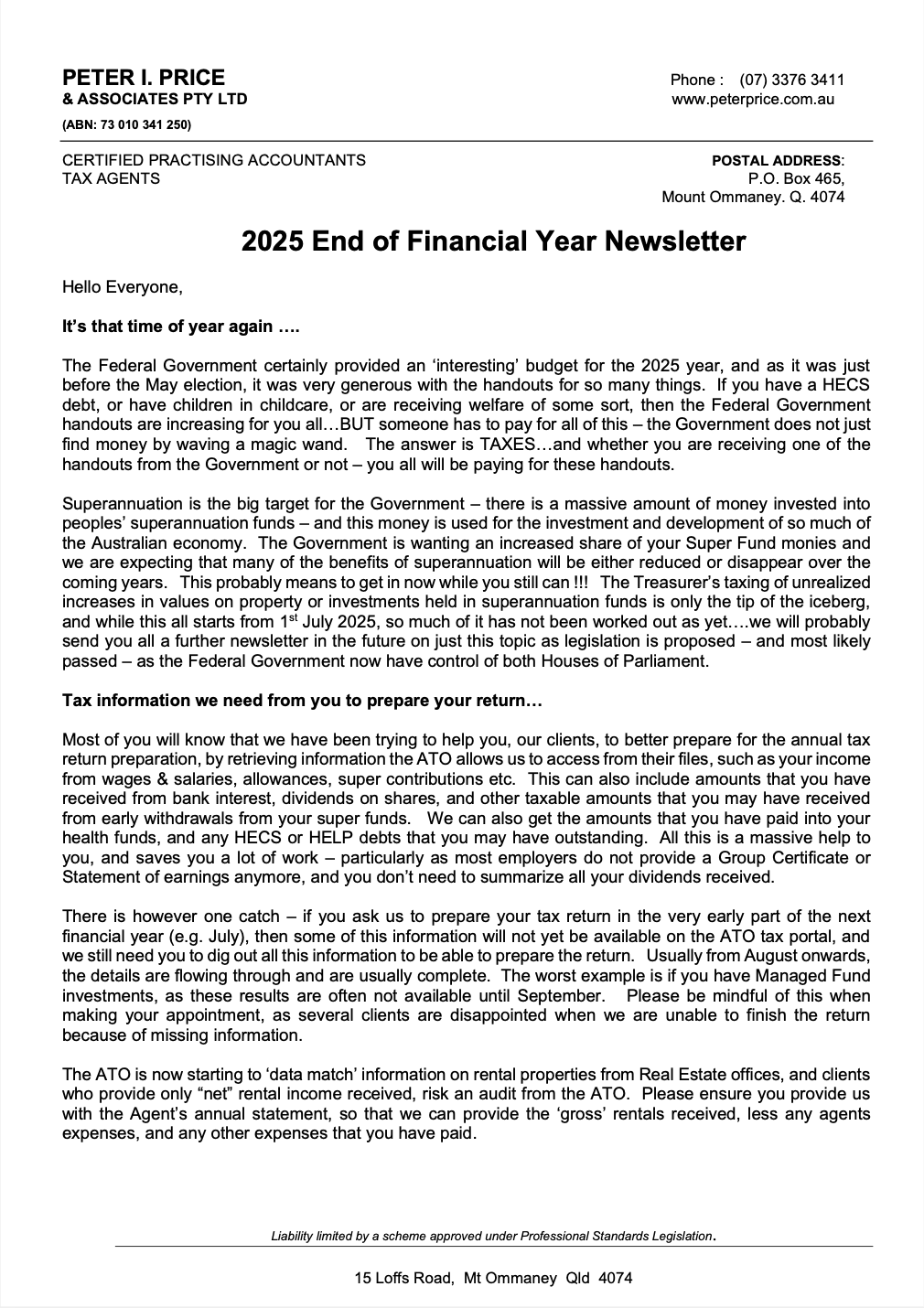
Latest Newsletter

2025 EOFY Newsletter

Secure File Transfer

Secure File Transfer is a facility that allows the safe and secure exchange of confidential files or documents between you and us.

Email is very convenient in our business world, there is no doubting that. However email messages and attachments can be intercepted by third parties, putting your privacy and identity at risk if used to send confidential files or documents. Secure File Transfer eliminates this risk.

Login to Secure File Transfer, or contact us if you require a username and password.

Disclaimer

Information provided on this web site is general in nature and does not constitute financial advice.

Peter Price & Associates has taken reasonable care in providing this information, unless expressly stated, it should not be construed as being specific to your investment objectives, financial situation or particular needs.

Peter Price & Associates will endeavour to update the web site as needed. However, information can change without notice and Peter Price & Associates does not guarantee the accuracy of information on the web site, including information provided by third parties, at any particular time.

This information is prepared for residents of Australia only. Any currency references are references to Australian dollars unless otherwise specified.

Unless otherwise specified, copyright of information provided on this web site is owned by Peter Price & Associates. You may not alter or modify this information in any way, including the removal of this copyright notice.

This web site does not offer securities or other financial products, nor does it invite subscriptions for securities or other financial products to any person outside Australia. Peter Price & Associates does not guarantee the repayment of capital or any particular return from, or any increase in, the value of any Peter Price & Associates products unless otherwise expressly agreed.

Further, Peter Price & Associates disclaims any liability for loss, damage, cost or other expense which you may incur as a result of any information provided on this web site, to the extent that such liability is not excluded by law.

Terms of Payment

Peter Price & Associates Pty Ltd adopts a strict 14 day payment term for all accounts rendered. Full payment of fees must be made 14 days from date of each invoice, unless otherwise agreed upon by Peter Price & Associates Pty Ltd.

You have the options of paying by credit card (Master Card or Visa Card), cash, cheque, money order, direct credit, or we can deduct our fees from your ATO refund. Please contact us for account details if your choose to direct credit to our account, we can also accept credit card payments via phone.

In the event that your payment is late, to the extent permitted by law, interest and charges for late payment will begin to accrue after 30 days from the due date. Payment plans can be arranged to avoid disruption to services. Any costs incurred by debt collectors will be added to outstanding fees payable.